20240505-P1090272

Reunion With Balinese Culture

We share a common interest in exploring the treasures of Nusantara, embracing its philosophy and adopting a mindful approach to nature.

We are very proud to announce that we have been invited to contribute to the Harvard Business School Reunion that took place at Desa Potato Head in Seminyak at May the 5th.

Our client, Meccaya, entrusted us to introduce Balinese culture to Harvard alumni during their reunion tour in Bali, alongside our project in Magelang. A joyful exchange of ideas between the two cultures—Chinese and Nusantara—resulted in fruitful insights for everybody.

We share a common interest in exploring the treasures of Nusantara, embracing its philosophy and adopting a mindful approach to nature. For instance, Desa Kala Patra, our foundational principle, which we firmly grasp throughout our design.

Sasta Jelantik, our Director of Operations, took the stage to represent our culture, philosophy, and the spirit of a Balinese. He captured the audience’s attention when he mentioned ‘Karang Awak,’ a philosophy from Ida Pedande Made Sidemen, about enriching our inner selves despite the lack of material possessions.

Afterward, Oryza Irawan took part in explaining our current project with Meccaya, our client. He is currently leading the design team of Padmastana Hotel & Resorts, located in Magelang, Central Java. He represents both SHL Asia and the Meccaya team in inviting Harvard alumni as investors for this cultural project.

Ricky Surya Prakasa, CEO of Meccaya, is most energetic when discussing this project. With his belief that this cultural project will significantly raise awareness of the Nusantara civilization, he successfully persuades the audience to take a closer look and become aware of our advanced ancient civilization, marked by the construction of Borobudur Temple. Together with Ferry Salim, the brand ambassador of Meccaya, they both invite Harvard alumni to take part in this cultural project and preserve the heritage of Nusantara throughout modernity. With his elegance, Ferry Salim successfully attracts the interest of the alumni.

As cultural agents representing our heritage to a foreign audience, SHL Asia is eager to ensure that Harvard alumni depart with a memorable souvenir. For all attendees, we provided our culture book ‘Timeless Harmony,’ complete with personal messages and autographs. SHL Asia and Meccaya believe that this book will leave a lasting impression on Nusantara culture. It serves as a tangible reminder of the essence of our event—a cultural exchange.

Eventually, amidst the ever-faster pace and advancement of technology, we hope that there is still room for Nusantara culture to flourish, preserving heritage and shaping the next generations. This culture is encapsulated within timeless design and harmonized with its surroundings—just like our book embodies, Timeless Harmony.

Here’s to a joyous reunion, bringing together Meccaya and esteemed Harvard alumni! Wishing you all a wonderful and memorable gathering filled with shared experiences and meaningful connections.

20240103-P1030589

Timeless Harmony in Saka Museum

All are aligned with our book, “Timeless Harmony,” as the spirit of Saka Museum is to preserve timeless pieces of Bali. Our book records the spirit of timelessness through philosophy, design, and photographs by Rusdi Sanad. Inside this book, the reader is informed of how the natural beauty of Bali is the result of the unique perspective of Balinese called Desa Kala Patra. It is a teaching to give respect to place, time, and situation to acquire balance in harmony and spirituality.

The opening year of two thousand twenty-four is marked by the inauguration of a landmark in Ayana Jimbaran. Saka Museum — the name resembling the caka calendar of Bali — is dedicated to preserving a collection of timeless fragments ranging from ancient to contemporary Bali. This art sanctuary is placed inside the luxurious Ayana Jimbaran property and stands unique with its intriguing forms.

From a distance, the museum looks like a compass needle, with its sharp edges and fast slopes. It stands above a giant reflecting pond, showcasing an outstanding engineering marvel. The design is delivered by Mitsubishi Sekkei Ltd from Japan, and its style is very apparent with its combination of a strong engineering statement. Despite access still being exclusive to Ayana guests, we had the opportunity to enter the Saka Museum as part of the arrangement to present our culture book, “Timeless Harmony,” to be included in a portion of the collection. The honor is ours, along with Rusdi Sanad, to place our work in this timeless sanctuary.

Upon our arrival, we experienced firsthand the neatness of Japanese design when creating a public space. All materials are considered very easy to maintain, and the neutral colors create an unassuming ambiance for whoever walks inside. Once inside, the modern museum is a splendid sight. With everything being minimalistic, it draws our attention more to the collection. The ground floor is filled with collections of ancient sculptures from Bali, paintings, and poetry. One area is dedicated to Nyepi and Kamasan painting. If we move further inside, there will be a series of documentation of the design process and construction of the Saka Museum took a total of 4 years to complete.

We are guided into the library where Saka Museum stores rare and ancient literature of Bali. It ranges from lontar leaves to the first copies of famous books, all stored very elegantly in fully customized displays and reading tables. The interior provides a feeling of calmness and is very modest in terms of color. What catches our attention is a collection of Pawukon calendars.

Bali has its own time, guided by a calendar named Pawukon. It is a wooden board that indicates the passing of days and marks fortunate or unfortunate dates. It follows the Saka calendar, consisting of eight traditional weeks or “wuku.” Using this calendar, the people of Bali decide the best time to start planting rice fields, build a temple, or commence any ceremony. This calendar is beautifully carved and used over time; therefore, its utility is timeless in the realm of Balinese culture.

All are aligned with our book, “Timeless Harmony,” as the spirit of Saka Museum is to preserve timeless pieces of Bali. Our book records the spirit of timelessness through philosophy, design, and photographs by Rusdi Sanad. Inside this book, the reader is informed of how the natural beauty of Bali is the result of the unique perspective of Balinese called Desa Kala Patra. It is a teaching to give respect to place, time, and situation to acquire balance in harmony and spirituality.

Upon arriving in the main library where the Saka Museum stored relics and rare collections of literature, Chandra, our principal of design, and I introduced the book to the Saka Museum’s curator. Rusdi Sanad gives a short and beautiful explanation of why we are collaborating to write this book, where readers could immerse themselves in the visual spectacle through Sanad’s lens. Hopefully, what we have done in this book could provoke others to take part in cultural preservation — as is the vision of Saka Museum. This kind of spirit is what keeps us doing what we believe.

Balinese Vibrance Through Generations

LANDSCAPE HYATT REGENCY BALI

Three decades later, in the late 2013s, Bali Hyatt announced its closing to commence a major renovation in its interior and landscape as an effort to stay relevant. This is where we began our journey when SHL Asia was trusted to design the landscape update to rebrand as a ‘Hyatt Regency Bali’.

Imagine walking down Danau Tamblingan road in the 1960s, in the morning, to catch the salt breeze of the Sanur coastline. Emerging from behind the grove of coconut skyline is the only high-rise structure, Bali Beach Hotel (now Grand Inna Bali Beach), stated as the kickstart of Balinese tourism. At the time, Sanur itself was already attracting tourists and artists to spend their holidays or even permanently stay there. Tourism in Southeast Asia was emerging as a promising prospect, so it is no wonder that Hyatt Hotel Corporation was aiming for expansion to Bali. The embryo took shape when Hyatt acquired a large piece of land originally purposed for a large hotel facility named Hotel Matahari and began the project in the late 1960s. The project was formally completed in 1973, becoming the first large hotel and resort to incorporate Balinese traditional design. This luxury was inaugurated under the brand of Bali Hyatt.

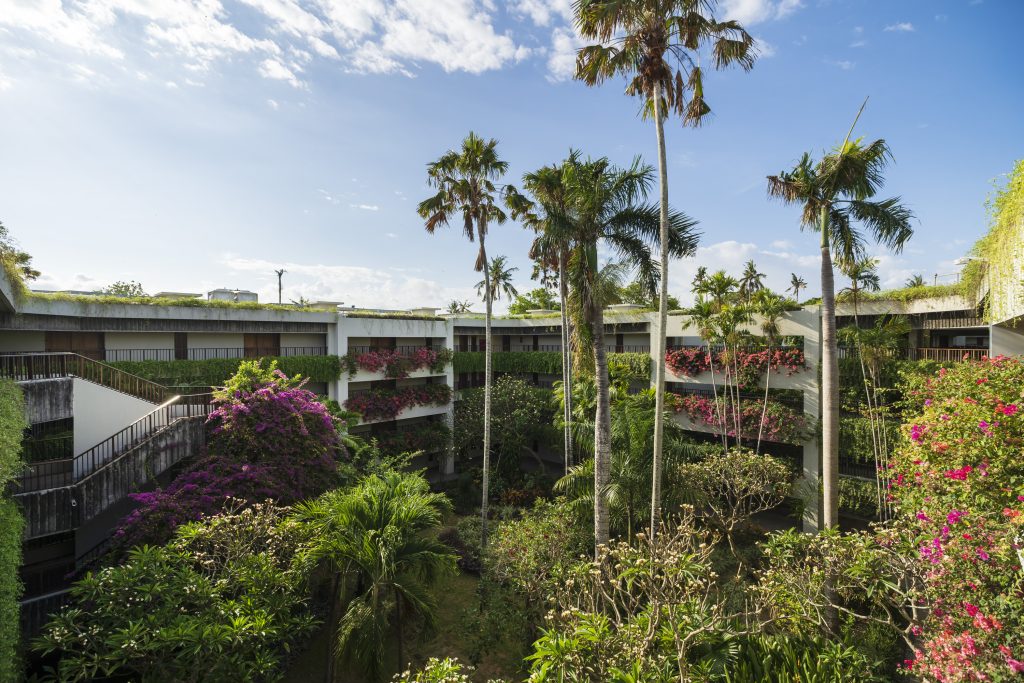
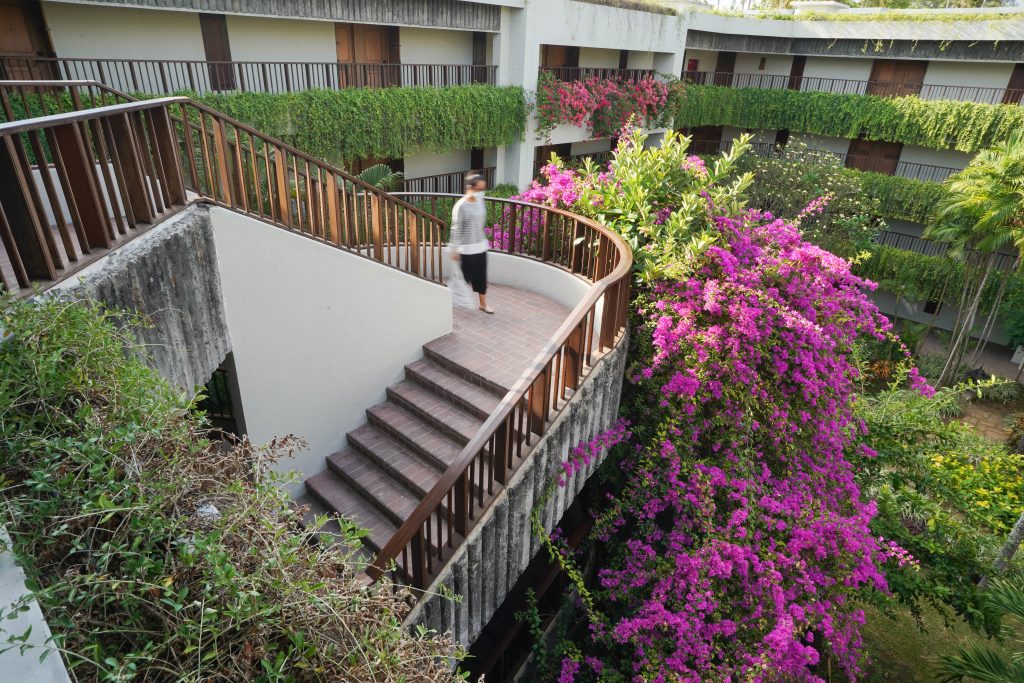
Bali Hyatt became the playground for various designers to witness their legendary touch. For instance, the grand design was crafted by Palmer and Turner, with Kerry Hill in charge of the project when he was still with their Hong Kong office. This resulted in the thatched roof long lobby and modern brutalist hotel block inside the bougainvillea garden. In the same decade, the design was finalized involving Geoffrey Bawa in the interior. In the 1980s, Made Wijaya and Bill Bensley provided their landscaping touch in Hyatt’s update. Three decades later, in the late 2013s, Bali Hyatt announced its closing to commence a major renovation in its interior and landscape as an effort to stay relevant. This is where we began our journey when SHL Asia was trusted to design the landscape update to rebrand as a ‘Hyatt Regency Bali’.

Taking a tour of the Hyatt, its entrance is already inviting from the very beginning. The entrance is full of vibrance and local materials indigenous to Sanur, much like the top of a Balinese offering adorned with flowers, signifying dignity in its local identity. If we look at Hyatt’s sister, Andaz, the contrast is very obvious as the latter prefers a simpler approach in terms of colorful ambience. The updates consist of rejuvenating the landscape ground cover finish with newer cobblestones and make it in pattern. Arriving at the roundabout of its drop-off, a thoughtful ‘Catur Muka’ sculpture signifies the four sacred directions – north, west, south, and east.

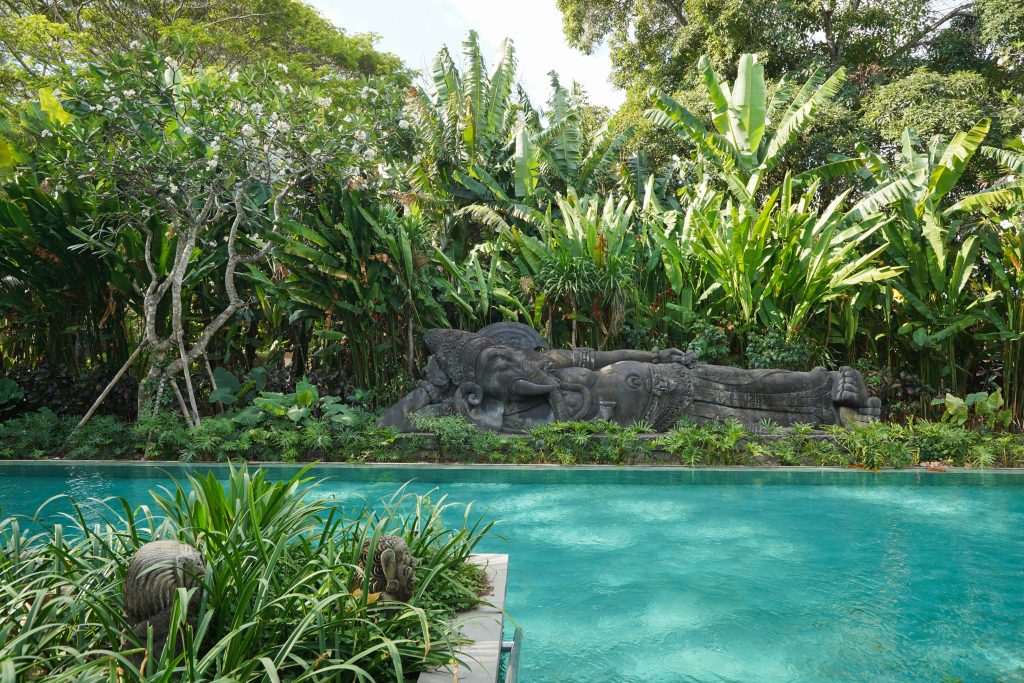
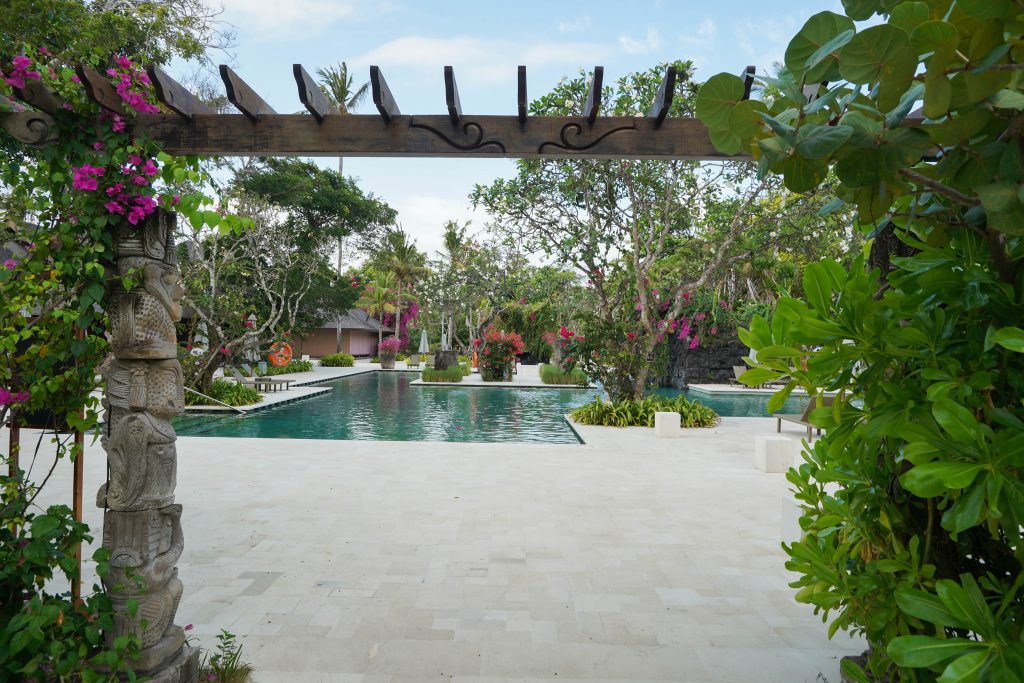
If the guest is familiar with the legendary Hyatt since the 70s, nothing has changed regarding the truest spirit of Hyatt’s Balinese tradition. The long hall designed by Kerry Hill remains intact, as does the modern brutalist hotel block with its cascade balcony. As landscape designers, we were led by the master plan from Tierra Design, responsible for the outdoor ambiance. Most of Made Wijaya and Bensley’s designs are left untouched, and we are working on a definitely new area closer to the coastline. The most obvious change will be the new swimming pool area adorned with majestic sculptures of ‘Goa Gajah’ and ‘Ganesha’ built-in local black stone. Around the pool, we still maintain the spirit of Balinese vibrance rich in flower culture.

The renovation work was completed in 2019, and the new face of Hyatt is surprising its loyal guests. A new generation of tourists is coming to Bali, expecting traditional hospitality with modern necessities under the rebranded entity: Hyatt Regency Bali. When we imagine how everything started in the 70s, with Hyatt standing as the pioneer of large-scale hospitality retreats, this update showcases that tradition and eternity lie in fluid adaptation to the generation. Joining forces with another top-tier designer of the world, SHL Asia leaves its mark on the legendary Hyatt.